The Agency That Sells Projects Gets Replaced First
Signal Leak
•
Framework
•
15
min read
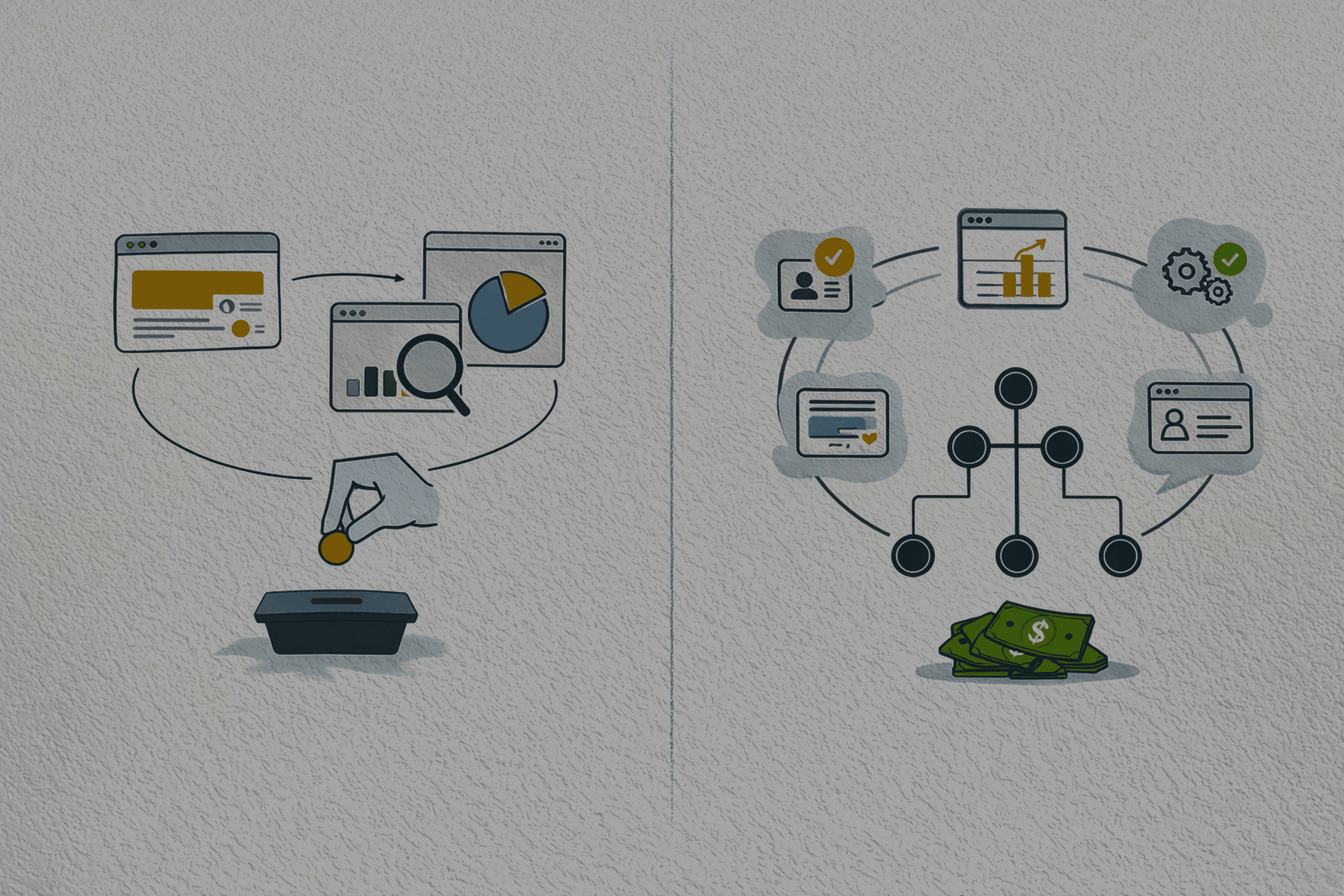
Most agencies still sell websites, SEO, branding, ads, retainers, content, CRO, or automation as separate services.
Clients do not buy those things because they want deliverables. They buy because they want growth. They want stronger conversion. They want a better sales process. They want more predictable revenue. They want less waste. They want fewer leaks. They want a business that feels easier to run.
But most agencies package the relationship around disconnected tasks.
One team builds the website. Another team runs ads. Someone else manages SEO. Reporting sits in a separate dashboard. The CRM is barely connected. The founder is still involved in every meeting.
Nothing feels connected. Nothing feels essential.
The client cannot clearly explain what the agency owns, what it improves, or what would happen if it disappeared.
That is why so many agencies feel replaceable.
This is not a design issue. It’s a signal architecture failure.
Why the Traditional Agency Model Breaks
The traditional agency model is simple.
Find a client. Sell a project. Deliver the work. Collect the payment. Start over.
That structure creates weak businesses.
Revenue becomes unpredictable.
Every month depends on new sales.
Payroll becomes stressful.
Hiring feels risky.
The founder stays trapped in constant selling, onboarding, delivery, revisions, reporting, and problem-solving. Even when revenue grows, the business often becomes harder to manage.
Many agencies reach $20k to $30k per month and start drowning.
At $50k to $60k per month, the founder often becomes the bottleneck for everything. More clients create more communication. More projects create more operational complexity. More employees create more management pressure. Growth stops feeling like leverage. It starts feeling like chaos.
That is why so many agencies break even when revenue looks healthy.
The problem is not usually lead generation.
The problem is that the business model itself is weak.
The website, CRM, ads, SEO, reporting, automation, and customer research sit in separate service buckets
The first project is treated as the main product instead of the first step into a larger system
Reporting focuses on activity instead of business impact
The client cannot clearly see what is improving month to month
The founder remains trapped in delivery, communication, revisions, onboarding, and account management
The agency depends on constant new sales because retention is weak
Each of these increases evaluation friction.
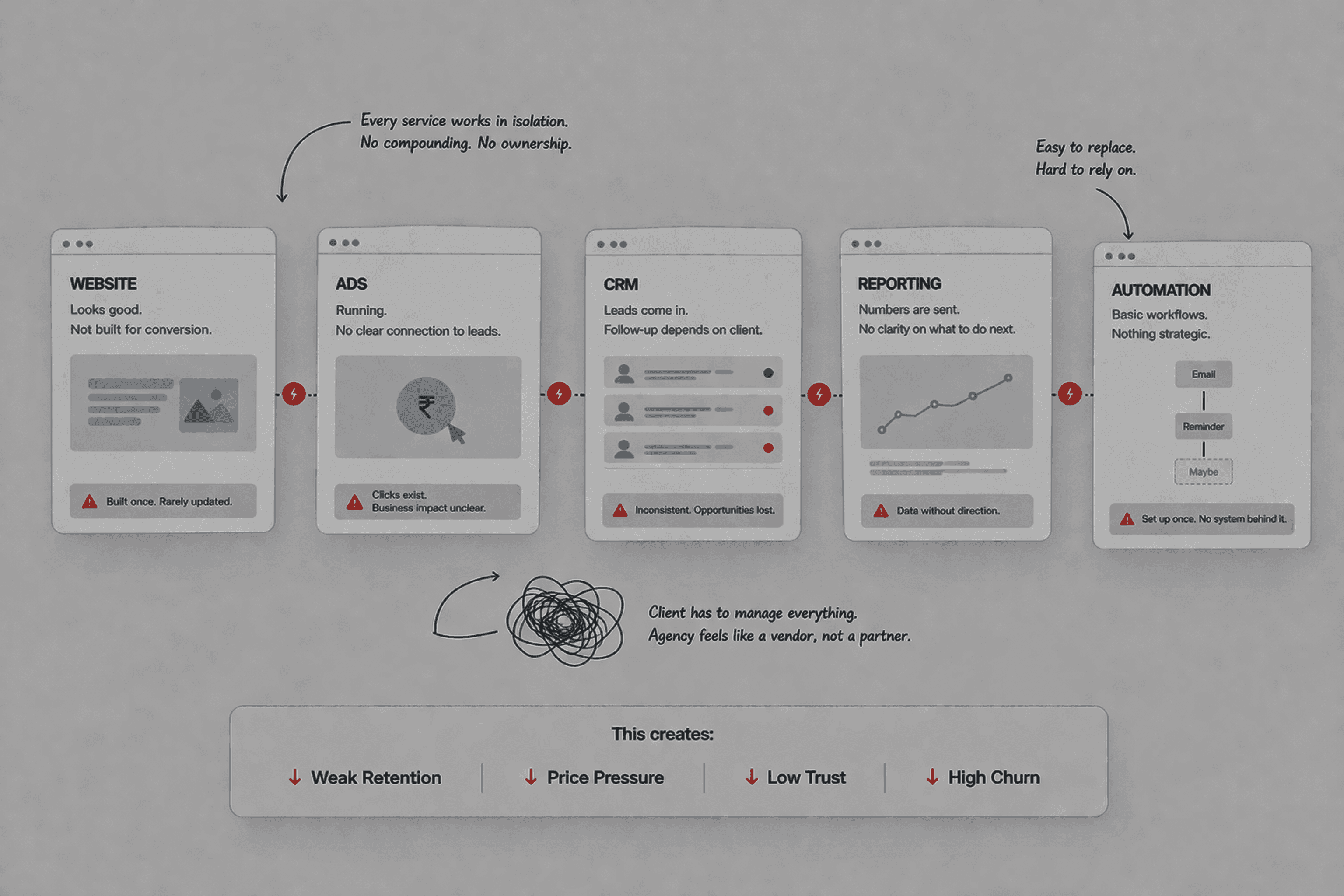
When an agency sells isolated deliverables, clients compare it to every other agency selling the same thing. The relationship becomes price-sensitive because the work feels interchangeable.
When the project ends, the value feels finished too. The client starts questioning why they should stay on a retainer if there is no clear reason for the relationship to continue.
When reporting only shows completed tasks, meetings, or campaign activity, the client cannot connect the spend to growth, revenue, or operational improvement.
When the founder is still involved in every revision, meeting, onboarding call, and operational issue, growth creates more stress instead of more leverage.
When the agency controls only one part of the client relationship, replacement becomes easy. The client can switch vendors without feeling much risk.
Time-to-Trust increases. High-value buyers leave before confidence forms.
AI is compressing the value of production work.
Basic websites, landing pages, SEO content, dashboards, research, reporting, copywriting, and automation are becoming cheaper and easier to produce.
Clients do not want to pay premium fees for simple execution anymore.
They want someone to decide:
What matters
What should happen next
What should be ignored
Where resources should go
What deserves attention
How every activity connects back to growth
The premium layer is moving away from production.
The premium layer is now:
Strategic direction
Decision-making
System design
Business context
Prioritization
Accountability
Integration
Ongoing improvement
The agencies that survive this shift will not be the ones that produce more work.
They will be the ones that own more of the client relationship.
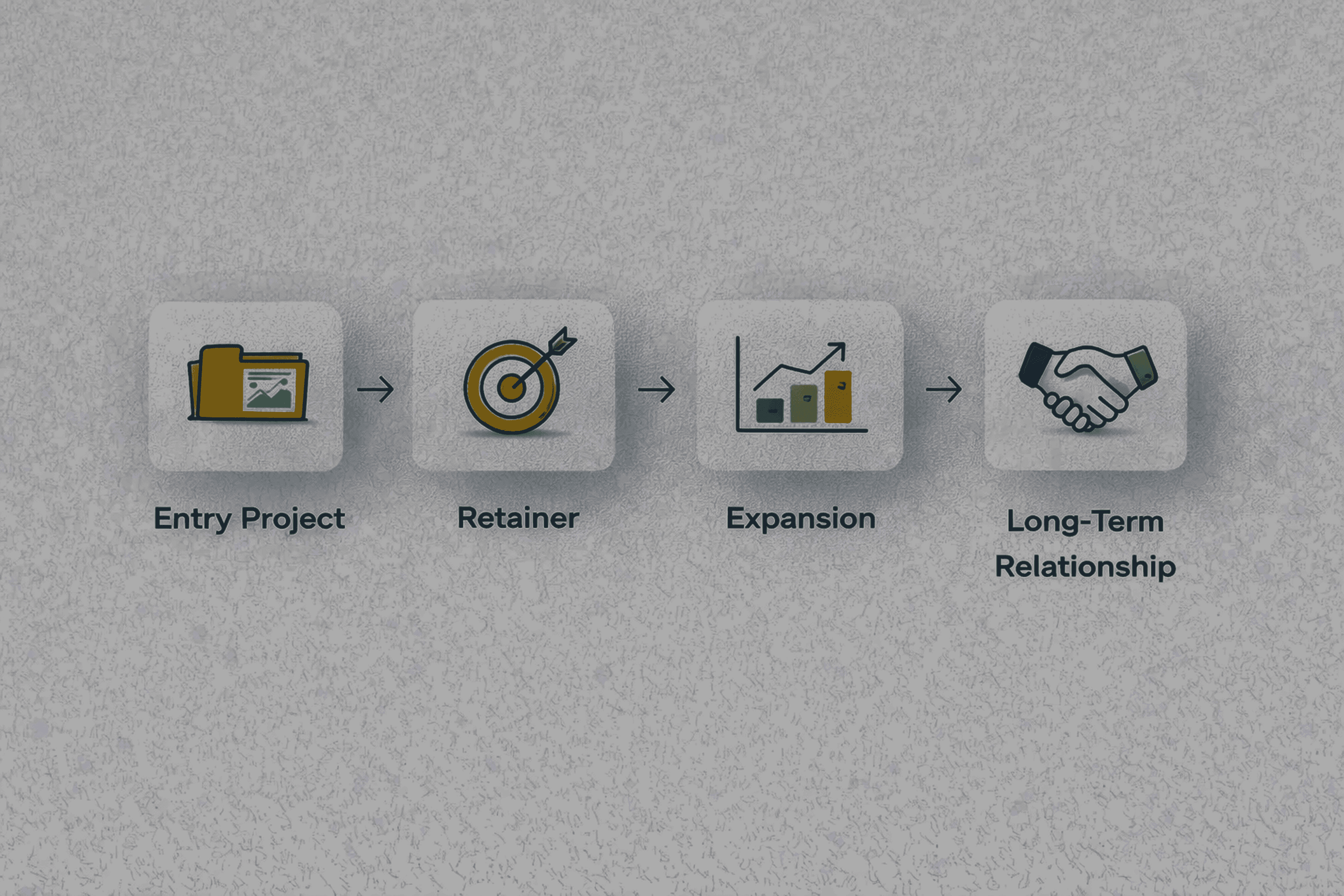
The strongest agencies are no longer treating the first project as the business.
The first project is only the entry point.
The real business starts after the project ends.
A website build, brand sprint, CRO audit, SEO roadmap, paid ads setup, or positioning workshop should only exist to bring the client into a much larger relationship.
Once the client is inside, the agency expands into:
Monthly retainers
Reporting and analytics
CRM management
Conversion optimization
Ongoing design and development
SEO and content expansion
Customer research
AI automation
Sales enablement
Email systems
Pipeline management
Internal team support
Strategic consulting
The more integrated the agency becomes, the harder it becomes to replace.
The client no longer sees the agency as a vendor.
The client sees the agency as part of the infrastructure of the business.
This is the real revenue flywheel. The first project creates the relationship. The relationship creates trust. Trust creates recurring revenue. Recurring revenue creates predictability. Predictability creates better hiring, stronger systems, lower stress, and better margins.
That is why one client paying $10,000 per month is often worth more than six clients paying $1,500 per month each.
Fewer clients usually means:
Better communication
Better service quality
Better reporting
Better retention
Better margins
More strategic involvement
Less chaos
Many agencies think they are growing when they are actually leaking.
An agency can add $20,000 in new monthly revenue while losing $15,000 in existing monthly revenue.
That is not real growth. That is just replacing lost revenue.
Churn destroys:
Profit
Forecasting
Team morale
Hiring confidence
Business stability
Valuation
The strongest agencies are not usually the ones with the most clients.
They are the ones with the strongest retention.
If clients stay for years, the business becomes more valuable because future revenue becomes easier to predict.
That is why many operators now care more about lifetime value than total client count.
The question is no longer:
How many clients do we have?
The question is:
How much is one client worth over three years?
Most clients do not leave because of one big mistake.
They leave because of accumulated friction.
Slow communication. Weak onboarding. Missed deadlines. Poor reporting. No visible progress. No new ideas. Too many meetings. Too much founder dependency. Weak account management. No clear connection between the work and business outcomes.
The client slowly starts questioning the value of the relationship.
That is why the strongest agencies constantly make progress visible.
They show:
New tests
New campaigns
New landing pages
New content angles
New reports
New dashboards
New automations
New conversion improvements
New strategic recommendations
The client should always feel that the business is moving forward.
Even if the work is good, a retainer starts feeling weak if nothing new is happening.
The strongest agencies do not stop at one service.
They build what can be described as a "client vault".
The client vault exists when the agency controls multiple parts of the growth engine at the same time.
That may include:
The website
The CRM
The analytics
The reporting
The ads
The email system
The appointment flow
The lead qualification process
The positioning
The automation layer
The customer research layer
The conversion process
Once all of these become connected, replacing the agency becomes painful.
The client would need to rebuild systems, retrain people, move data, find new vendors, and risk losing momentum.
That is what creates retention. Not lock-ins. Not long contracts.
Real retention comes from becoming genuinely difficult to replace.
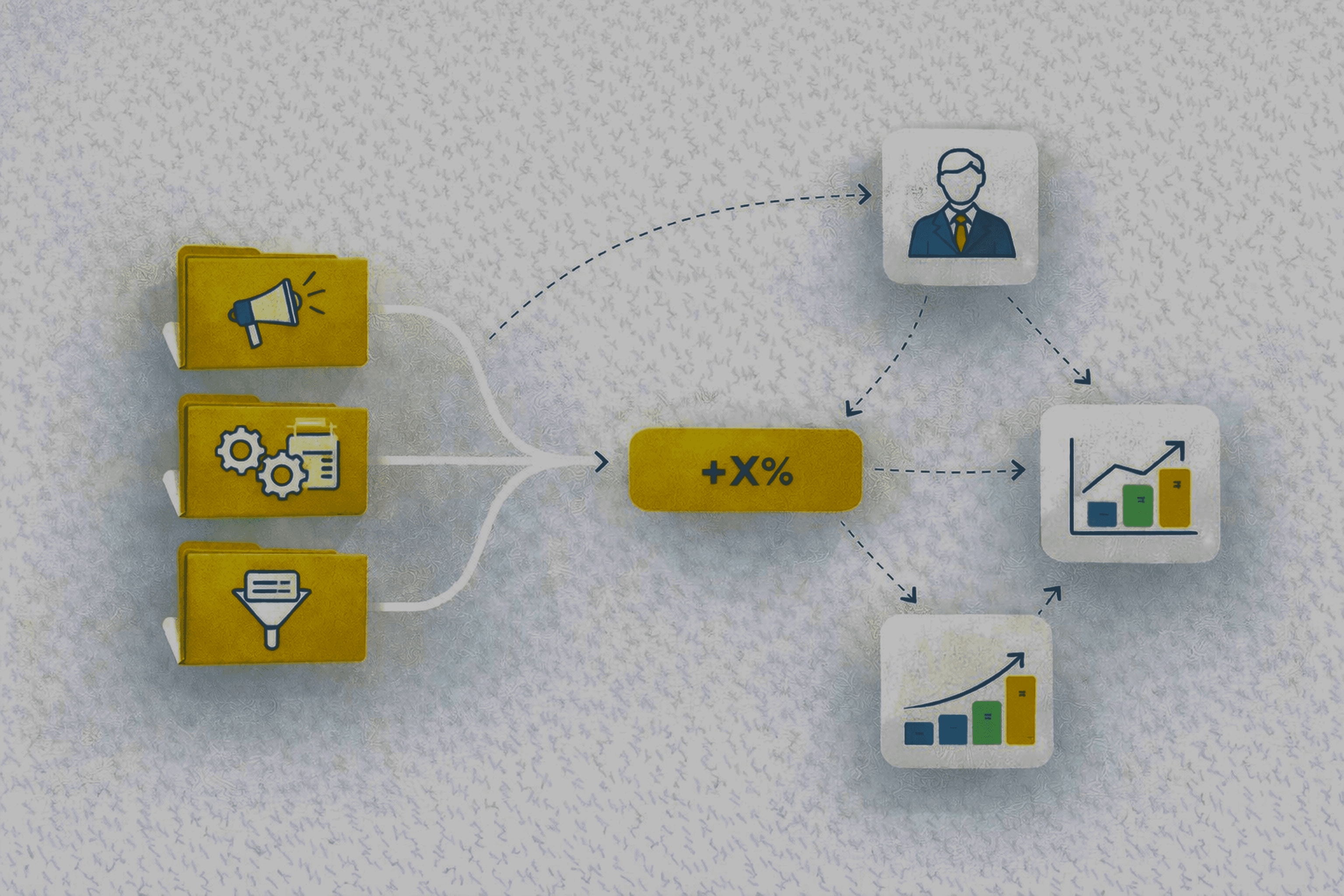
The strongest version of this model is the diagnostic agency
Instead of pitching services, the agency reveals problems.
The front door is not a portfolio.
It is a calculator.
An evaluator.
An audit.
A scorecard.
A revenue leak tool.
The client enters their numbers.
Traffic.
Close rate.
Average deal size.
Lead quality.
Conversion rate.
Pipeline value.
The system shows what they are losing and why.
That changes the entire sales process.
The prospect already understands the problem before the first call.
The agency no longer needs to convince them they have a problem.
The client already saw the number.
This solves several problems immediately.
It reduces expectation mismatch.
It filters out poor-fit clients.
It removes weak leads before discovery calls.
It makes the value of the work easier to explain.
It creates stronger trust before the sales process even starts.
The diagnostic should not stop after onboarding.
It should continue running every month.
The client should always be able to see:
What improved
What stayed flat
What is still leaking
What the next opportunity is
That is how an agency makes value visible.
That is how an agency keeps clients longer without forcing them into lock-ins.
The Structural Fix
Positioning Shift
Stop selling websites, branding, ads, SEO, or retainers as separate services.
Position the agency as the system that identifies problems, fixes them, and keeps finding the next thing worth improving.
The client should feel like they are buying business infrastructure.
Not isolated production work.
Hierarchy Change
The first project should not be framed as the product. It should be framed as the entry point. The real value should come from the longer-term relationship after the project is complete. The initial engagement exists to create trust, show results, and open the door to recurring work.
Proof Compression
Clients need visible evidence.
Do not rely on vague monthly updates. Do not rely on long reports nobody reads.
Show:
Revenue recovered
Lead quality improvements
Conversion improvements
Faster close rates
Better pipeline quality
Lower friction
Stronger retention
Time saved
The client should be able to explain the value of the relationship in one sentence.
Conversion Path
The strongest agency model follows this structure:
Low-friction entry-point project
Clear proof of business impact
Ongoing retainer tied to visible outcomes
Expansion into more services over time
That is how a website project becomes a three-year relationship.
That is how a $5,000 monthly retainer becomes a $20,000 monthly account.
That is how agencies grow without relying on constant new sales.
Why Systems Matter More Than Talent
Many agency founders think they need better people.
In reality, they usually need better systems. Without systems, even talented people fail.
The strongest operators repeatedly rely on:
SOPs
Checklists
Templates
Dashboards
Reporting systems
Playbooks
Internal documentation
Standardized onboarding
Clear communication rules
Repeatable delivery systems
The goal is not to create bureaucracy.
The goal is to remove chaos.
Every time something breaks, the process should improve. Every repeated question should become documentation. Every repeated mistake should become a checklist. Every confusing onboarding step should become a clearer system.
That is how agencies become scalable.
The Founder Has To Fire Themselves
Most founders start by doing everything —
Sales.
Delivery.
Client calls.
Reporting.
Hiring.
Admin.
Finance.
Strategy.
That works at the beginning.
But if the founder keeps doing everything forever, the business becomes impossible to scale.
The founder has to gradually replace themselves with:
Systems
Team members
Specialists
Automation
Documentation
Clear processes
The founder should constantly ask:
What am I still doing that someone else could do with the right process?
The strongest founders are not the ones who stay involved in everything.
They are the ones who remove themselves from low-value work so they can focus on relationships, positioning, growth, and strategy.
The agencies that win in 2026 will not be the ones with the best-looking websites.
They will not be the ones with the biggest teams.
They will not be the ones offering the most services.
They will be the ones that make themselves the hardest to remove.
The strongest agency is not a creative studio.
It is not a freelancer collective.
It is not a production house.
It is a recurring revenue system.
The website is only the entry point.
The retainer is only the mechanism.
The real product is control. Control over reporting. Control over customer insight. Control over the CRM. Control over conversion. Control over growth. Control over what happens next.
That is what makes an agency survive. That is what makes an agency scale. That is what makes an agency difficult to replace.